

Our Ceramic Manufacturing Process
From engineering consultation through finished production, every step of our manufacturing process is designed to produce ceramic components that meet your performance requirements, quality standards, and delivery expectations.
No two ceramic components are manufactured the same way. The optimal production process depends on the part geometry, material, performance requirements, production volume, and final tolerances.
At Associated Ceramics, our engineering team works with customers to determine the best manufacturing approach for every project. With in-house tooling, multiple forming methods, precision machining, firing, and finishing capabilities, we can support everything from prototype development to high-volume production of millions of parts each year.
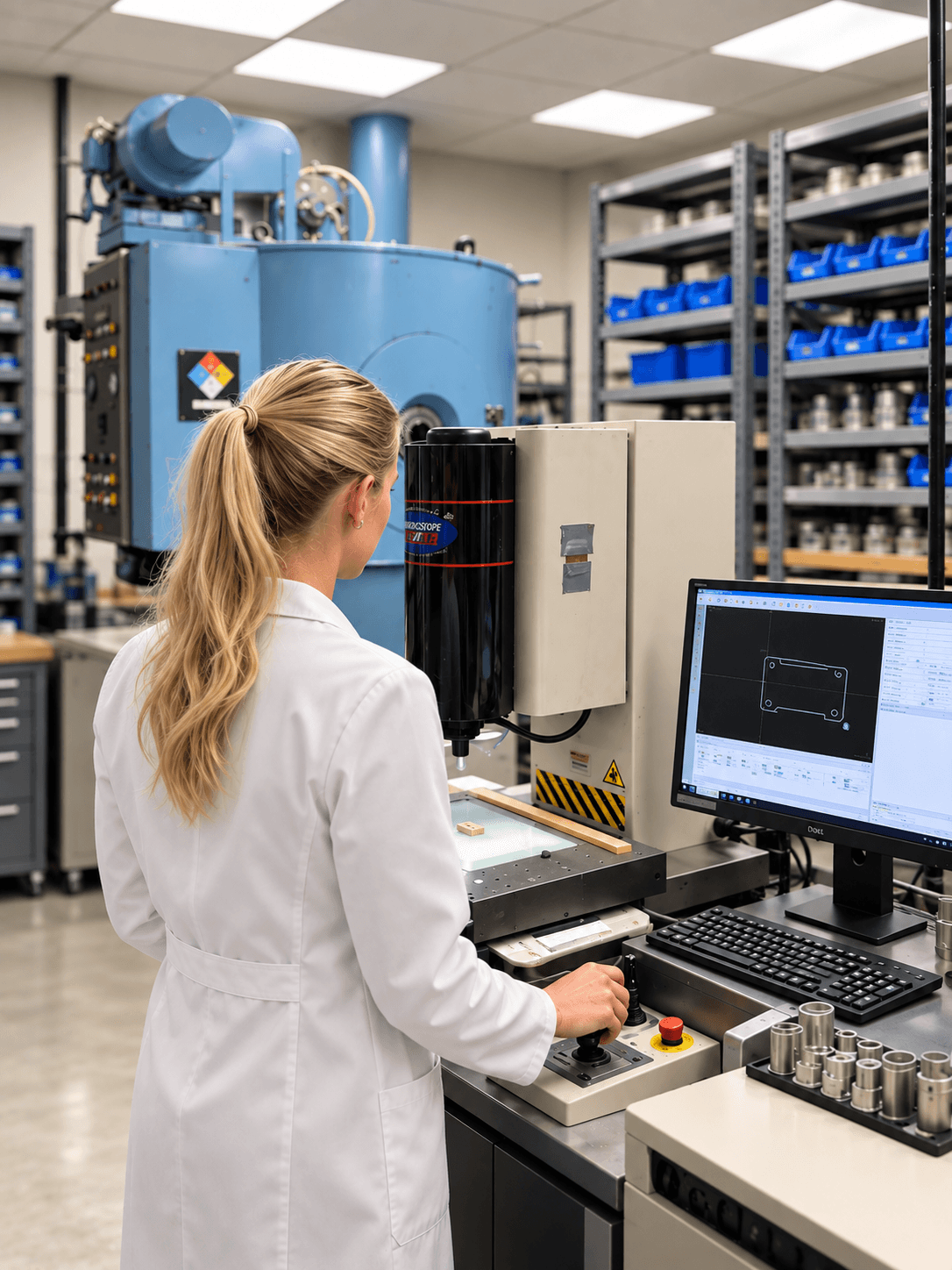
From Design to Delivery
Every project follows a manufacturing process tailored to its unique requirements.
Our typical production process includes:
- Engineering Review
- Tooling Design
- Forming (Pressing or Extrusion)
- Green Machining (when required)
- Firing (Sintering)
- Precision Grinding & Finishing
- Inspection, Quality Control & Delivery
Not every ceramic component requires every manufacturing step. Our engineering team selects the process—or combination of processes—that best balances performance, manufacturability, cost, and production efficiency.
Engineering & Tooling
Our ceramic engineers, manufacturing engineers, and tool designers work closely with customers to optimize designs before production begins. By developing tooling in-house, we improve dimensional consistency, manufacturing efficiency, and repeatability while reducing variation over long production runs.
Capabilities:
- In-house tool shop
- 3D CAD tooling design workstations
- Tool maintenance and repair
- Rapid turnaround on original tooling designs
Pressing
Pressing is one of the most common manufacturing methods for technical ceramic components.
Prepared ceramic powder is compressed inside a rigid die under high pressure to create green components ready for firing. This process provides exceptional repeatability, dimensional consistency, and production efficiency for high-volume components.
Multiple pressing methods are available to accommodate different component sizes, geometries, tolerances, and performance requirements. Our engineering team selects the most appropriate process based on your application, production volume, and material.
With more than 155 production presses ranging from 2 to 250 tons, including multi-cavity tooling, we can manufacture over 1.5 million ceramic components per day.
Dry (Uniaxial) Pressing
Dry (uniaxial) pressing is the preferred manufacturing method for many high-volume ceramic components with simple to moderately complex geometries.
During this process, dry ceramic powder is compressed in a rigid die from a single direction (one axis), producing near-net-shape components with excellent dimensional consistency and repeatability. Because tooling is designed specifically for each part, dry pressing provides outstanding production efficiency and low piece-part costs.
This process is commonly used for electrical insulators, electrical element supports, structural ceramic components, studs, spears, lock washers, and many other precision ceramic parts.
Benefits include:
- Excellent dimensional consistency
- High production efficiency
- Low piece-part costs
- Minimal material waste
- Repeatable quality across millions of components
Process Specifications
- Components up to 20 square inches
- Multi-cavity tooling for increased production efficiency
- Capable of producing complex geometric shapes
- Standard tolerance: ±1% or ±0.005", whichever is greater
Isostatic Pressing
Isostatic pressing applies pressure uniformly from all directions rather than along a single axis.
This process produces ceramic components with highly uniform density throughout the part, making it an excellent choice for larger components, thicker cross-sections, and specialized geometries where consistent material properties are critical.
Isostatic pressing is often selected for custom ceramic components that require enhanced structural integrity or cannot be efficiently manufactured using conventional die pressing.
Benefits include:
- Uniform pressure applied from all directions
- Excellent density uniformity
- Ideal for larger or more complex geometries
- Suitable for specialty and custom components
Extrusion
Extrusion is used for ceramic components with continuous cross-sectional profiles that cannot be efficiently produced through pressing.
Ceramic material is forced through a precision die to create long, uniform shapes before being cut to length and, when necessary, machined in the green state. This process is ideal for producing rods, tubes, sleeves, and custom profiles with consistent cross-sections.
Common applications include:
- Rods
- Tubes
- Sleeves
- Custom profiles
- Long ceramic components
Process Specifications
- Solid rods from 0.025" to 1.5" outer diameter
- Tubing up to 2" outer diameter
- Minimum wall thickness of 10%
- Seven extrusion presses up to 250 tons
- Green-state cutting and machining available
- Standard Tolerances for outer diameter, inner diameter and length: ±1% or ±0.0005", whichever is greater
- Caber tolerance: 0.006" per inch of length
Green Machining
Some ceramic components require features that cannot be produced during the initial forming process.
Green machining takes place before firing while the ceramic remains relatively soft. This allows holes, grooves, slots, and other intricate features to be added more efficiently than machining fully fired ceramics.
Green machining is commonly used for:
- Prototype components
- Complex geometries
- Additional formed features
- Designs requiring minimal post-firing machining
Process Specifications
- CNC machining of complex ceramic geometries
- Automatic form grinding for intricate shapes
- Multi-hole machining for ceramic tubing
- Prototype machining
- Green-state machining prior to sintering
Firing (Sintering)
Firing, or sintering, transforms compacted ceramic powder into a dense, durable engineering material.
During this carefully controlled thermal process, ceramic particles bond together at high temperatures, developing the mechanical strength, electrical insulation, thermal stability, and wear resistance required for demanding applications.
Associated Ceramics operates both continuous and batch kilns to support a wide range of ceramic materials, production volumes, and firing profiles.
Process Specifications
- Over 20 sintering kilns, including laboratory kilns
- Gas-fired and electric kilns
- Ten automatically cycled production kilns
- Two continuous firing kilns
- Firing temperatures up to 3,200°F (1,760°C)
Precision Grinding & Finishing
Some applications require tolerances beyond what can be achieved through forming and firing alone.
Precision grinding is performed after firing to produce critical dimensions, precision mating surfaces, and improved surface finishes while maintaining the integrity of the ceramic material.
Grinding is commonly used to achieve:
- Tight tolerances
- Precision flatness
- Improved surface finishes
- Critical final dimensions
- Precision mating surfaces
Process Specifications
- Automatic precision grinders
- Precision surface grinding
- Lapping services available
- Superior surface finishes
- Standard tolerance: ±1% or ±0.0005", whichever is greater
Inspection, Quality Control & Delivery
Quality doesn't stop when manufacturing is complete. Every box of ceramic components is inspected before it leaves our facility because our philosophy is, "almost right, is still wrong".
As an ISO 9001:2015 certified manufacturer, we maintain rigorous quality standards throughout production, with final inspection serving as a critical last check on dimensional accuracy and finished product quality. It's how we stand behind the components we manufacture and help ensure our customers receive parts they can depend on.
Custom Ceramic Machining
Not every ceramic component can be manufactured using standard forming methods alone.
Associated Ceramics provides precision ceramic machining services for both customer-supplied materials and components manufactured in-house. Whether producing prototypes, modifying existing components, or machining complex production parts, our experienced machinists work closely with engineers to achieve the required geometry and tolerances.
Our machining capabilities include:
- Turning
- Milling
- Drilling
- Threading
- Slotting
- Surface grinding
- Precision finishing
- Prototype machining
- Production machining
Whether you're producing a single prototype or scaling into production, we'll recommend the machining strategy that best supports your application.
Understanding Our Manufacturing Process
Every ceramic component follows a unique production path based on its material, geometry, tolerance requirements, and end-use application.
While every part is fired, not every part requires extrusion, machining, or grinding. Our engineers select only the manufacturing steps necessary to achieve your performance requirements as efficiently as possible.
| Manufacturing Step | Why It's Used | Typical Applications |
|---|---|---|
| Engineering & Tooling | Optimize the design and prepare production tooling | Every new project |
| Dry (Uniaxial) Pressing | Form precise ceramic shapes for efficient production | Electrical insulators, heater supports, structural ceramics |
| Isostatic Pressing | Produce components with highly uniform density | Larger, thicker, or specialized ceramic components |
| Extrusion | Produce continuous ceramic profiles | Rods, tubes, sleeves |
| Green Machining | Add complex features before firing | Prototype, custom components and complex geometries |
| Firing (Sintering) | Develop the ceramic's final strength and performance properties | Every ceramic component |
| Precision Grinding | Achieve critical dimensions and surface finishes | Tight-tolerance applications |
| Custom Machining | Create or modify finished ceramic parts | Specialized geometries or secondary operations |
Why Manufacturers Choose Associated Ceramics
Manufacturing precision ceramic components requires more than specialized equipment. It requires engineering expertise, process control, and a commitment to consistent quality.
Manufacturers partner with Associated Ceramics because we provide:
- More than 60 years of technical ceramic manufacturing experience
- Ceramic engineers, manufacturing engineers, and tool designers involved in every project
- Multiple forming, machining, and finishing capabilities under one roof
- Prototype-to-production manufacturing support
- ISO 9001:2015 certified quality management
- High-volume manufacturing capacity with dependable delivery
- Consistent quality backed by decades of production experience
Let's Find the Right Manufacturing Process for Your Application
Whether you're developing a new ceramic component, replacing an existing part, or scaling from prototype to production, our engineering team can help identify the material, manufacturing process, and finishing methods that best fit your application.
Request a Quote
Frequently Asked Questions
What is the ceramic manufacturing process?
Technical ceramic manufacturing typically includes engineering review, tooling, forming (such as dry pressing or extrusion), green machining when required, firing (sintering), precision grinding, inspection, and delivery. The exact process depends on the material, geometry, performance requirements, and production volume.
What is the difference between dry pressing and extrusion?
Dry pressing compresses ceramic powder into precision tooling and is best suited for high-volume components with consistent geometries. Extrusion pushes ceramic material through a die to create continuous profiles such as rods, tubes, and sleeves.
What is green machining?
Green machining is the process of machining ceramic components before they are fired. Because the ceramic is still relatively soft, complex features can be added more efficiently than after sintering.
Why are ceramic components ground after firing?
Precision grinding is used to achieve tighter dimensional tolerances, improve surface finishes, and create precision mating surfaces once the ceramic reaches its final hardness.
Can Associated Ceramics manufacture custom ceramic components?
Yes. Associated Ceramics manufactures custom technical ceramic components from prototype through full-scale production. Our engineering team helps determine the optimal material, tooling, manufacturing process, and finishing requirements for every application.
Ready to Discuss Your Application?
Whether you're developing a new component, searching for a better supplier, or scaling an existing design into production, our engineers are ready to help.